
AI Is Changing the World. Is the Market Paying Too Much for It?
Credit stress, negative free cash flow, rising oil prices and a more restrictive Federal Reserve are testing the assumptions behind the AI boom.

The 4 Pillar Trader
10 min read
The biggest risk in today’s market may not be that artificial intelligence fails. It may be that AI succeeds, but investors have paid too much for the companies building it.
AI infrastructure spending is accelerating, but financing costs, cash generation and valuations are attracting greater scrutiny.
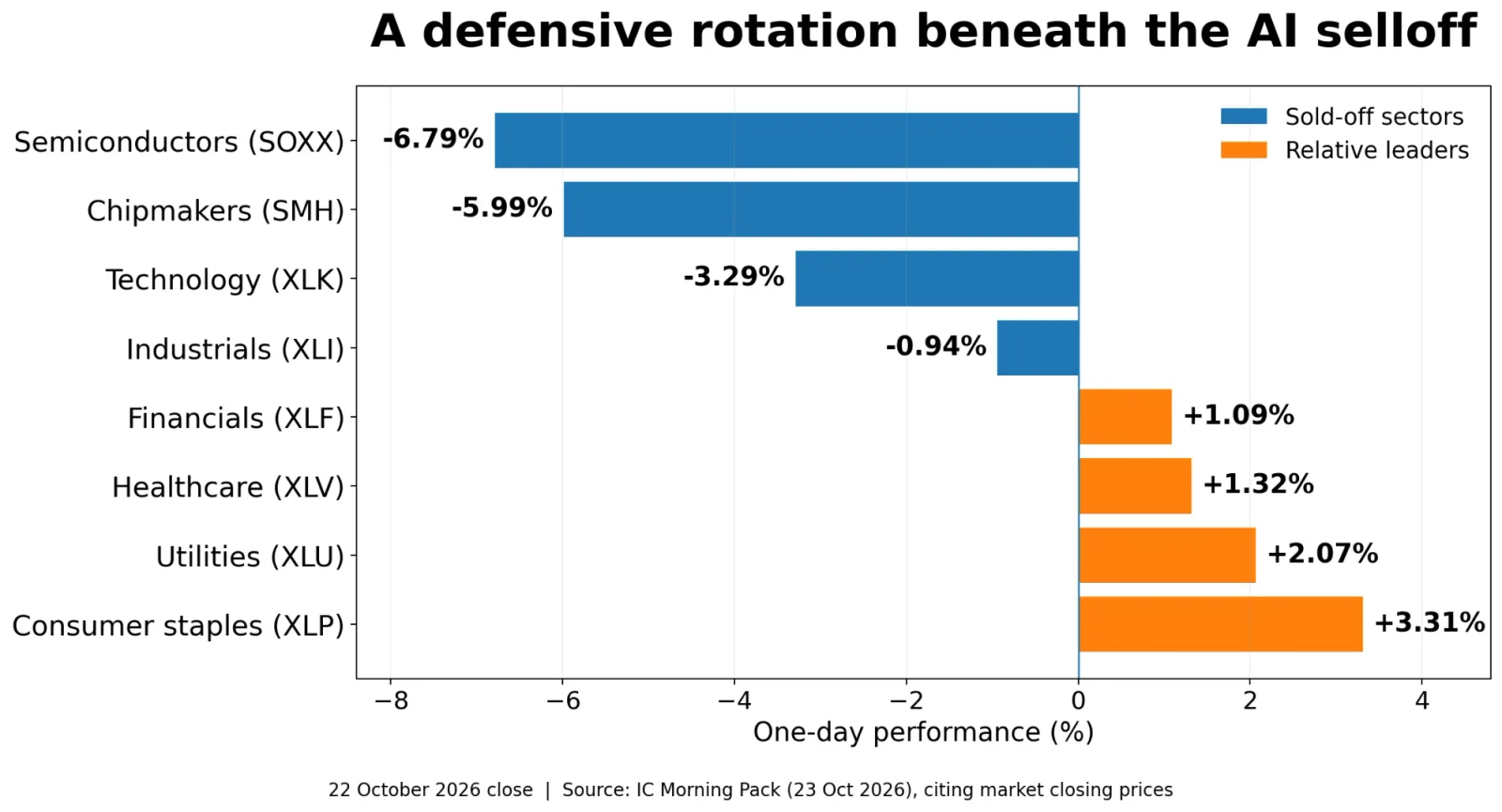
On 22 October, the Nasdaq fell 2.6%, the S&P 500 lost 1.21%, and the semiconductor ETF SOXX dropped 6.79%. Meanwhile, consumer staples gained 3.31% and utilities rose 2.07%. Investors were rotating from growth towards defensive businesses.
Our 23 October macro regime assessment reads the environment as late-cycle reflation with a defensive tilt. Two things are being judged separately. The regime, meaning whether the system has broken: not yet, because high-yield credit spreads, the VIX, jobless claims and flat small caps describe a rotation rather than a liquidation. And the tilt, meaning where the pressure is falling: on the high-beta, credit-stressed part of the market. Activity remains resilient, but inflation and credit stress leave markets vulnerable to disappointment.
1. AI’s weak point is the cost of capital
CoreWeave is becoming a useful barometer of stress in AI infrastructure financing.
The company operates specialist cloud infrastructure, renting access to the expensive computing capacity needed to train and run AI models. That requires debt-funded spending on chips, data centres and power.
CoreWeave’s five-year credit default swap (CDS) spread reached approximately 1,115 basis points on 22 October, according to our macro pack. A CDS is a contract used to insure against a borrower defaulting. When its spread widens sharply, investors are demanding significantly more protection against credit risk.
It does not establish that CoreWeave will default. It signals concern about debt sustainability and whether contracted demand will generate cash quickly enough.
Other neoclouds face similar exposure: weaker demand, faster equipment obsolescence or higher refinancing costs can alter projected returns.
Importantly, this is not yet a market-wide credit crisis. Our pack puts the US high-yield option-adjusted spread at 3.27%, below its 3.75% risk-off review threshold. The pressure is concentrated in highly leveraged AI-related borrowers, not uniformly across corporate credit.
A concentrated warning is not proof of systemic breakdown.
2. Revenue growth is no longer enough
Meta’s latest earnings illustrate how market expectations are changing.
Third-quarter revenue rose 26% to $64.6 billion, and the company remained profitable. Yet its shares fell roughly 7% on 22 October. Investors were focused less on revenue growth than on the scale and financing of its AI spending, alongside its proposal for a new class of non-voting shares.
Meta generated $32.79 billion in operating cash flow but spent $34.91 billion on capital expenditure, including finance lease principal payments. Its quarterly free cash flow was negative $2.12 billion. The company now expects $135 billion to $145 billion of capital expenditure in 2026.
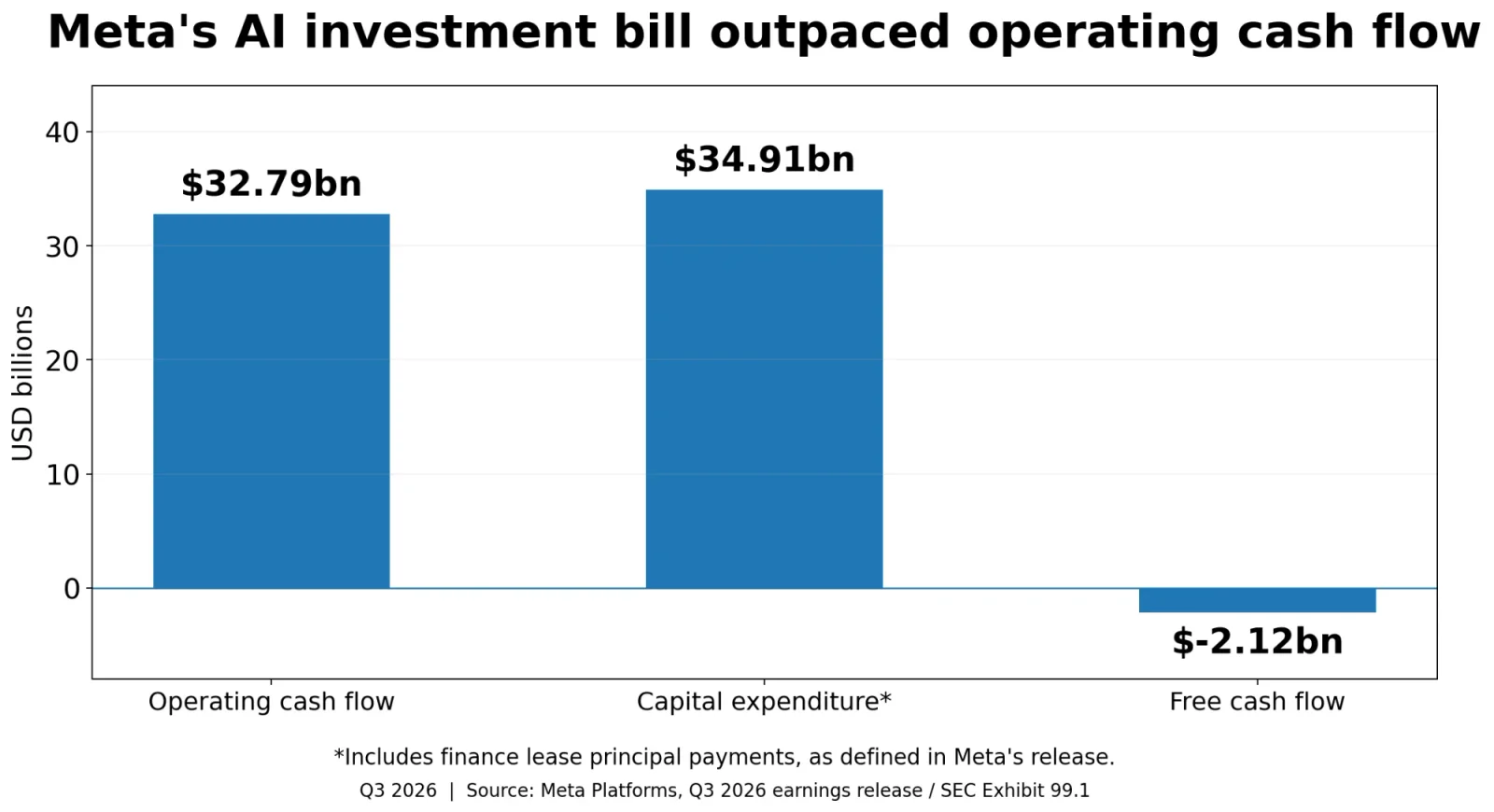
Meta remains profitable and liquid, but its negative free cash flow shows the cost of the infrastructure race.
For weaker balance sheets, contracts and forecasts cannot service debt until converted into cash.
This is the market’s emerging challenge to the AI narrative: how much future profit must materialise to justify the price investors are paying today?
3. The macro regime is making the trade harder
Our latest regime assessment identifies inflation as the dominant risk, with a growing probability of a demand slowdown. Its internal scenario weights favour inflation pressure (79%) over a demand break (18%). These are judgements, not crash probabilities.
Oil is the clearest problem. Brent crude settled at $113.17 a barrel on 22 October, up 4% for the session and its ninth consecutive settlement above $105. Attacks on Saudi energy infrastructure have added a geopolitical risk premium to prices.
Higher oil costs pressure businesses and households, while limiting central banks’ ability to ease policy if growth slows.
The Federal Reserve raised its policy rate by 25 basis points in September to 3.75% to 4.00%. As of the latest pack, futures implied a 94.3% probability of no change at the 28 October meeting, but a 76.4% probability of at least one further increase by December. Rate-hike expectations eased during the selloff but remain significant.
There is tension beneath the headline data. Initial US jobless claims fell to 194,000, suggesting layoffs remain contained, while continuing claims rose to 1.728 million, pointing to a slower hiring environment. US manufacturing new orders remained expansionary at 55.3, but elevated prices-paid measures still signalled cost pressure. Euro-area consumer confidence weakened to -17.9.
The result looks stagflationary: persistent inflation alongside slowing demand, without a clear recession signal or assured rate relief.
4. The bond market is sending a different warning
The US ten-year Treasury yield dropped 17 basis points on 22 October to 4.96%, while the two-year yield declined to 4.65%.
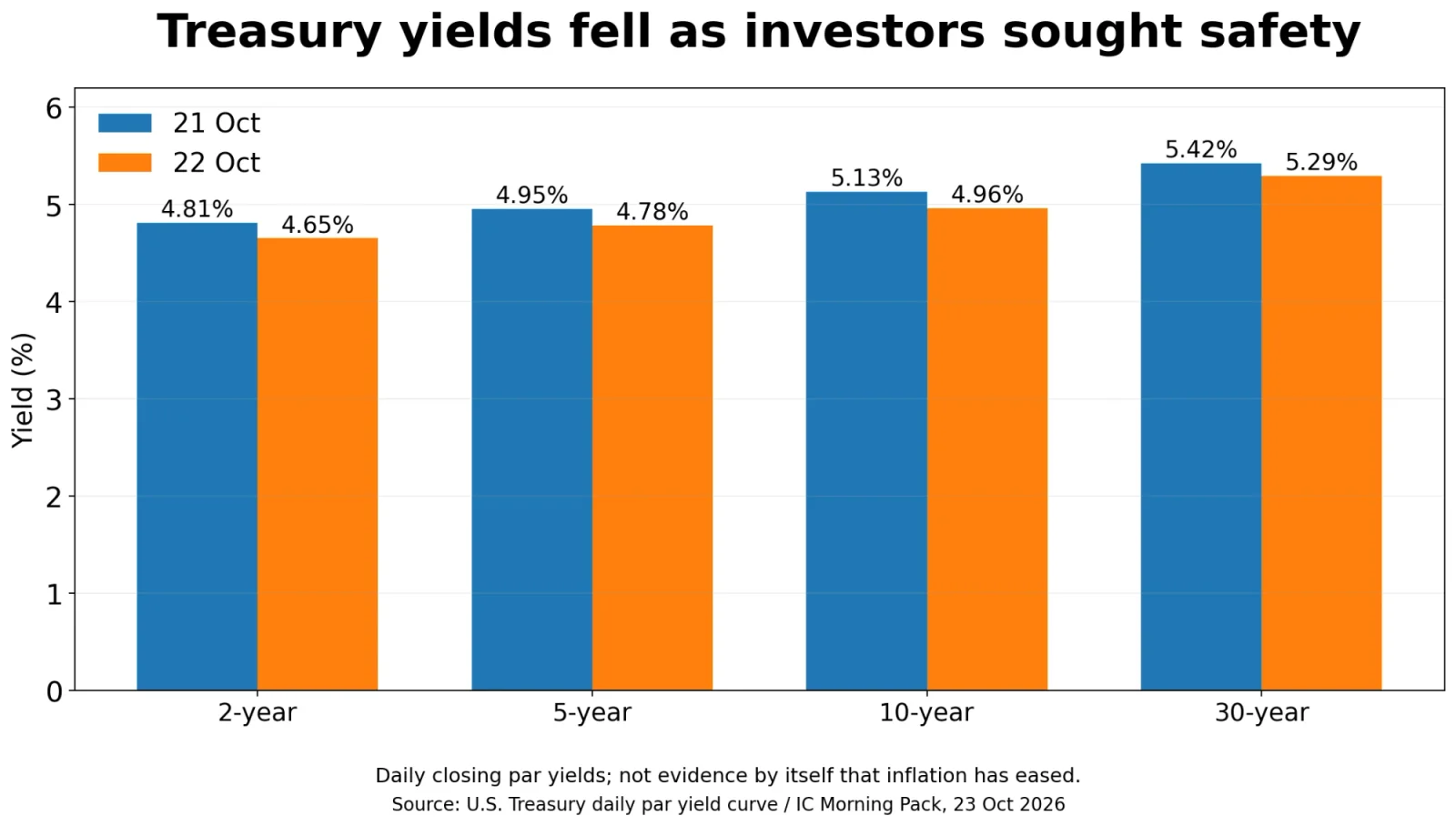
Lower yields can support growth valuations, but their cause matters.
At the same time, the five-year inflation breakeven rose from 2.40% to 2.45%, oil surged, and technology shares sold off. Investors were buying Treasuries for safety, not necessarily celebrating the end of inflation.
Falling yields alongside rising near-term inflation expectations capture the dilemma: investors fear inflation and disappointing growth investments.
Liquidity also deserves attention. Our pack records a roughly $59.5 billion weekly decline in reserve balances as the US Treasury’s cash balance increased. That reduces a short-term cushion without establishing a liquidity crisis.
5. The market’s internal rotation cannot be ignored
Broad index levels can conceal important changes beneath the surface.
On 22 October, the VIX rose approximately 14% to 19.03. Semiconductor stocks were hit hard, while staples, utilities and healthcare outperformed. Since 5 October, industrials have underperformed utilities by 9.24 percentage points in our macro framework.
That divergence suggests capital is becoming more selective. Investors still see economic growth, but are less willing to pay any price for cyclical exposure or distant earnings.
Yet the evidence is mixed. The Russell 2000 finished slightly higher on the day, and broader high-yield credit spreads have not crossed our risk-off threshold. A decisive market-wide breakdown is not yet confirmed.
Watch participation, credit and leadership together rather than extrapolating one Nasdaq decline.
What would change the assessment?
A useful macro view needs clear conditions for being wrong. Our regime pack flags a US high-yield credit spread above 3.75%, a VIX above 25 or Brent above $118 as reasons to review whether the rotation has become something broader. A sustained narrowing in CoreWeave’s CDS below 1,000 basis points would suggest some easing in AI-specific credit stress.
Oil and policy are equally important. A Brent settlement below $105 would reduce the immediate energy-pressure signal. A ten-year Treasury yield below 4.90%, alongside December rate-hike odds below 60%, would warrant reassessing the interest-rate backdrop.
Next week’s Federal Reserve decision and inflation data will help determine whether this remains a concentrated repricing of expensive AI investments or develops into wider financial stress.
6. Cybersecurity is another test of technological resilience
Two critical vulnerabilities in PHP, a widely used website programming language, prompted urgent security advisories this week. Attackers could potentially exploit affected, unpatched systems to run unauthorised code.
The claim that seven in ten websites were attacked is incorrect. PHP is used by around 69% of websites whose server-side programming language can be identified. That is a measure of usage, not the proportion compromised.
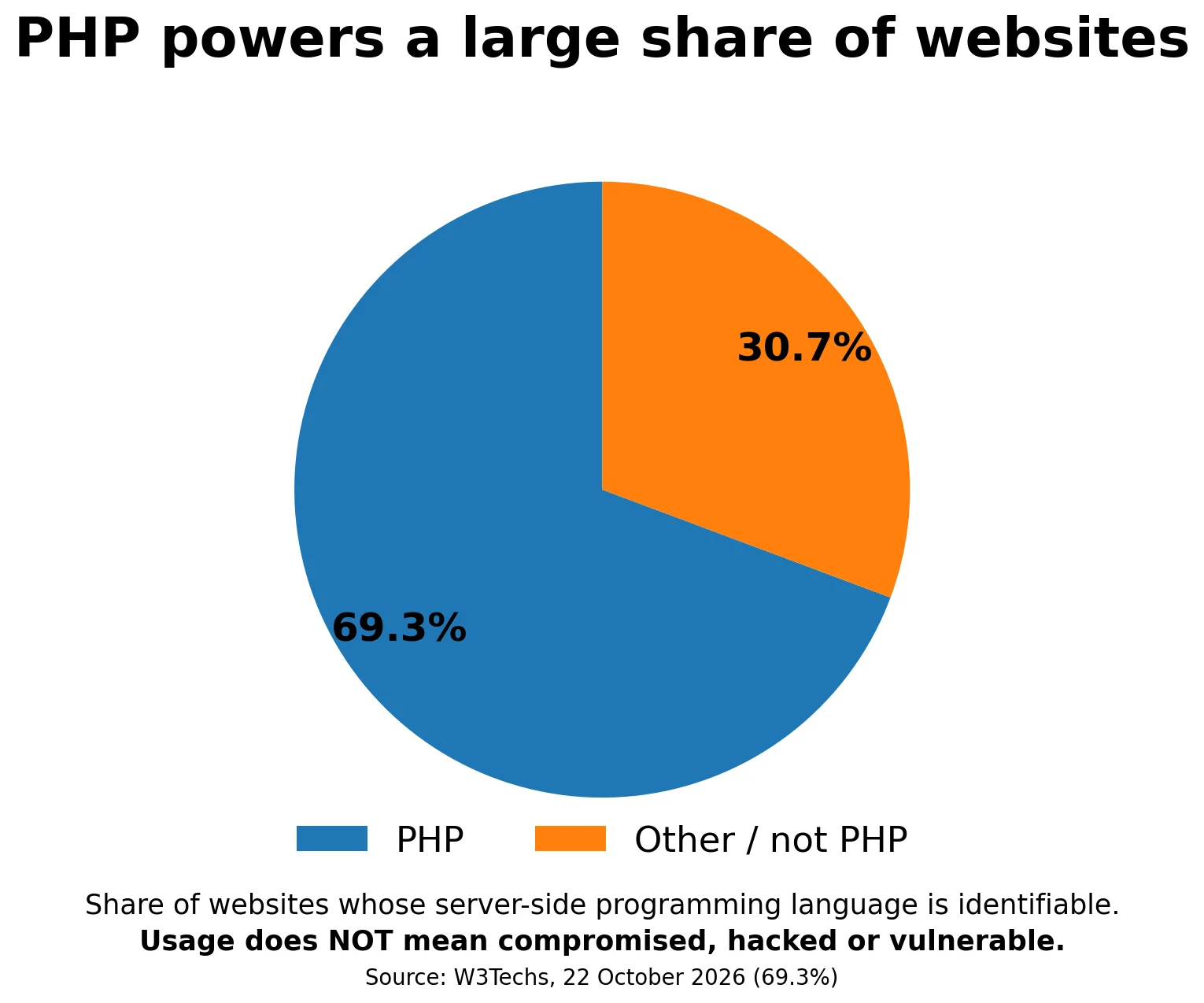
Widespread adoption means a serious flaw can propagate risk across interconnected systems. AI could accelerate both defensive research and attacks.
This is not direct evidence that AI stocks are overvalued. It is evidence that technological progress brings operational risks that investors should not overlook.
7. The dot-com comparison: three lessons
The late-1990s internet boom offers a useful parallel. Investors correctly anticipated that the internet would transform the economy. Many nevertheless paid valuations that assumed extraordinary future success, while weaker businesses relied on fresh financing to survive.
Unlike many dot-com start-ups, leading AI companies already generate huge profits. The resemblance is stronger in leveraged infrastructure, optimistic projections and assumed financing access.
Our recent dot-com documentary on the 4 Pillar Trader YouTube channel walks through that period in full. It highlights three lessons.
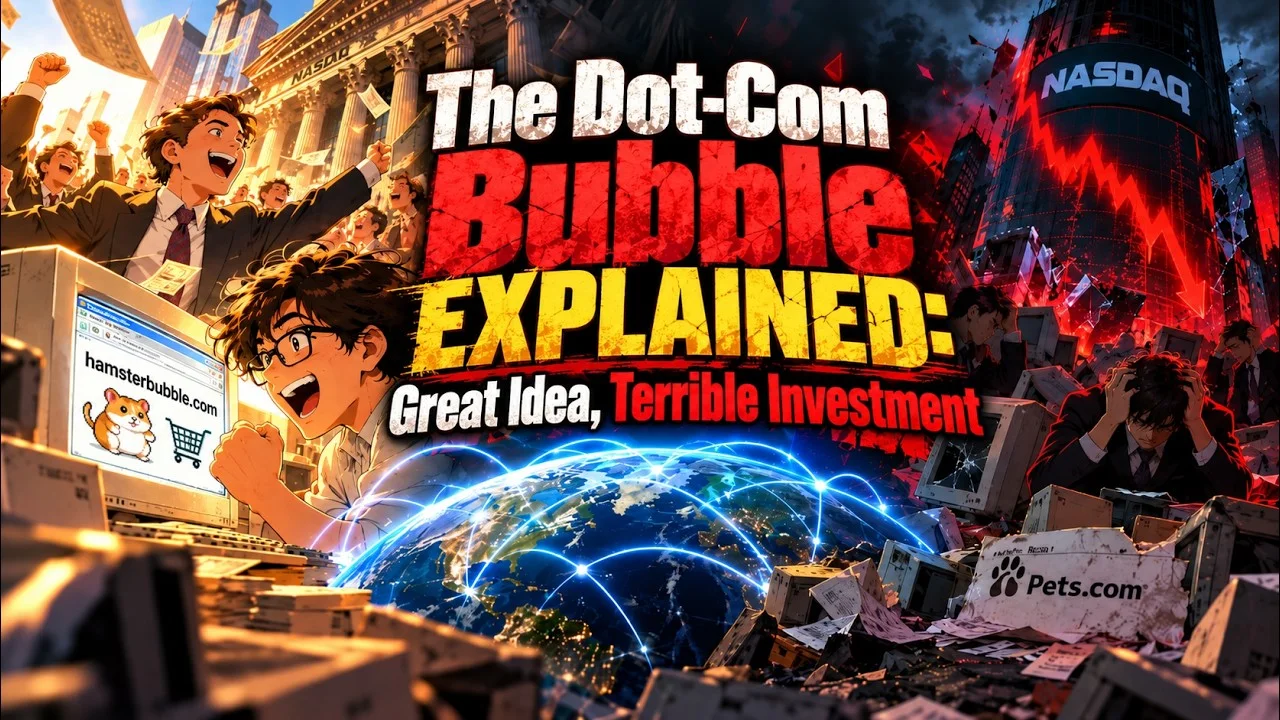
A great idea is not necessarily a great investment. Assess the economics of the business and the expectations embedded in its valuation.
The macro environment matters. Interest rates, energy costs, liquidity and access to capital determine what companies can fund and what investors will pay.
Risk management matters most when the story is convincing. Know what would invalidate the thesis, how exposed the portfolio is to the same theme, and what limits potential losses.
These lessons connect directly to the four pillars of the approach this site reviews: macro, fundamentals, options and strategies, and portfolio and risk. It is the same process 4 Pillar Trading teaches session by session.
The question has changed
AI can reshape the economy while individual AI investments disappoint.
The current market is questioning the funding model as much as the technology: rising credit insurance costs, enormous capital spending, energy-driven inflation and shifting sector leadership all point to a narrower margin for error.
Rather than predicting a crash, the educational point is the discipline: test a valuation against cash flow, financing conditions and downside risk before believing the story.
Being right about the future is not enough. What matters is what you pay, and how you manage the risk.
If you want this kind of assessment every week, the newsletter carries the regime view and the figures behind it.
Educational commentary only. Not personal financial advice. The 4 Pillar Trader is an independent affiliate of 4 Pillar Trading and may earn a commission if you join through links on this site.
Questions this article answers
Is the AI boom a bubble like the dot-com era?
Is the AI boom a bubble like the dot-com era?
The parallel is in leveraged infrastructure, optimistic projections and assumed access to financing, not in the companies themselves. Unlike most dot-com start-ups, the leading AI companies already earn large profits. The question the market is now asking is whether the capital being spent will earn an adequate return, which is a valuation and financing question rather than a technology one.
Why does CoreWeave's credit default swap spread matter?
Why does CoreWeave's credit default swap spread matter?
A credit default swap insures against a borrower defaulting, so its spread is the market's price for that risk. A spread around 1,115 basis points on 22 October 2026 says investors want a lot of protection against CoreWeave's debt-funded data-centre build. It does not mean default is likely; it means the cost of capital for leveraged AI infrastructure has risen sharply.
What would show the AI selloff had become something broader?
What would show the AI selloff had become something broader?
The article's own review triggers: a US high-yield credit spread above 3.75%, a VIX above 25, or Brent above $118 would be reasons to reassess whether a concentrated repricing of expensive AI investments had become wider financial stress. A sustained CoreWeave CDS below 1,000 basis points would point the other way.
Filed under Macro. The pillar it belongs to is set out in full on the four pillars.
Access Established directly through the founding offer
Access 4 Pillar Trading's Established membership directly through the founding offer, without the Foundation pathway it otherwise requires. Try it for 30 days for US$19, then keep a locked rate of US$269.10 a month against US$299 at list. Cancel before day 31 and pay nothing more. Pricing and inclusions are set by 4 Pillar Trading and can change, so confirm the terms on the checkout page before you commit.
Start the 30-Day Established Trial (opens in a new tab, affiliate link) opens 4pillartrading.com
Affiliate link. We may receive a commission if you join through it, at no additional cost to you.