
Newsletter issue
The regime, the five findings, and what to watch this week: 19 October 2026
A defensive rotation on an AI financing scare and hot inflation. Where the money went, what broke, and the handful of things that decide next week.
Last updated
Hi,
Here is the week in three parts. The kind of market we are in, the findings that mattered most, and what to pay attention to next. The three reports behind it are at the bottom.
The regime
This was a defensive rotation, not a broad selloff and not a broadening.
Two shocks hit at once. First, the AI hardware trade broke on a financing scare rather than an earnings miss. TSMC raised its growth outlook and ASML beat and raised, and chip stocks fell anyway, because CoreWeave, a company that borrows heavily to build AI computing capacity, saw its bonds trade near a 15 percent yield. The market story became that AI spending is running ahead of the money available to pay for it. Second, inflation ran hot. Consumer prices rose 0.6 percent in September and producer prices 1.3 percent, both above forecasts, while oil went back above 100 dollars on attacks around the Strait of Hormuz.
Money went to large, boring, cash-generating companies. Consumer staples, oil producers, insurers and managed care led. The typical large company rose 1.7 percent on the week. The typical small company fell 4.1 percent. Low-volatility names beat high-volatility names by about 9 points. Only about half of the stocks in the core universe rose, and only a quarter of small caps did.
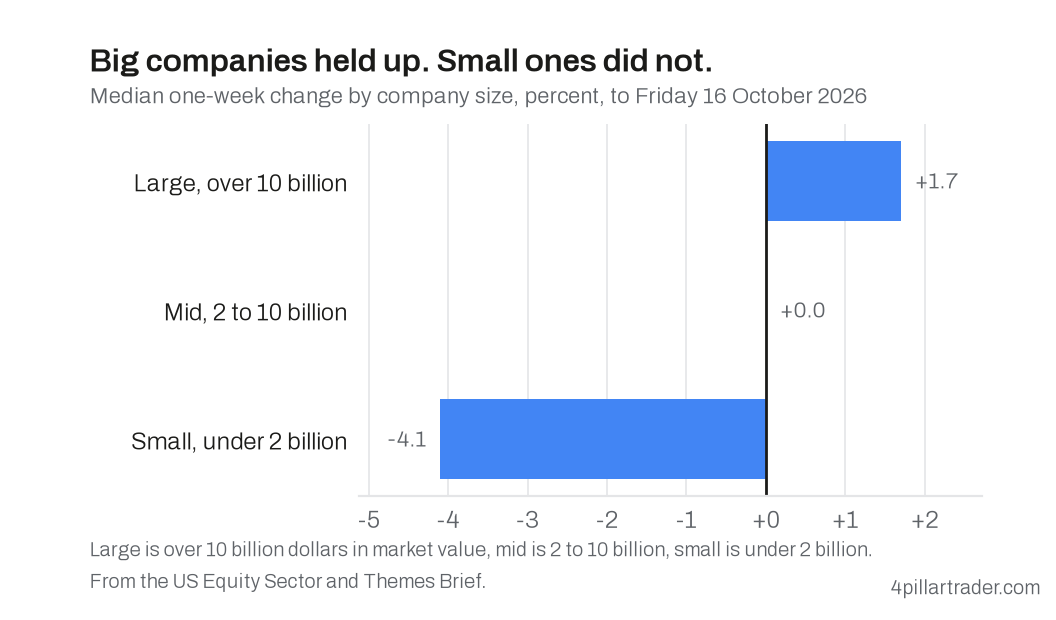
In plain terms. Investors did not leave the market. They moved to the safest corners of it and sold anything that depends on cheap borrowing to grow.
The five findings that mattered
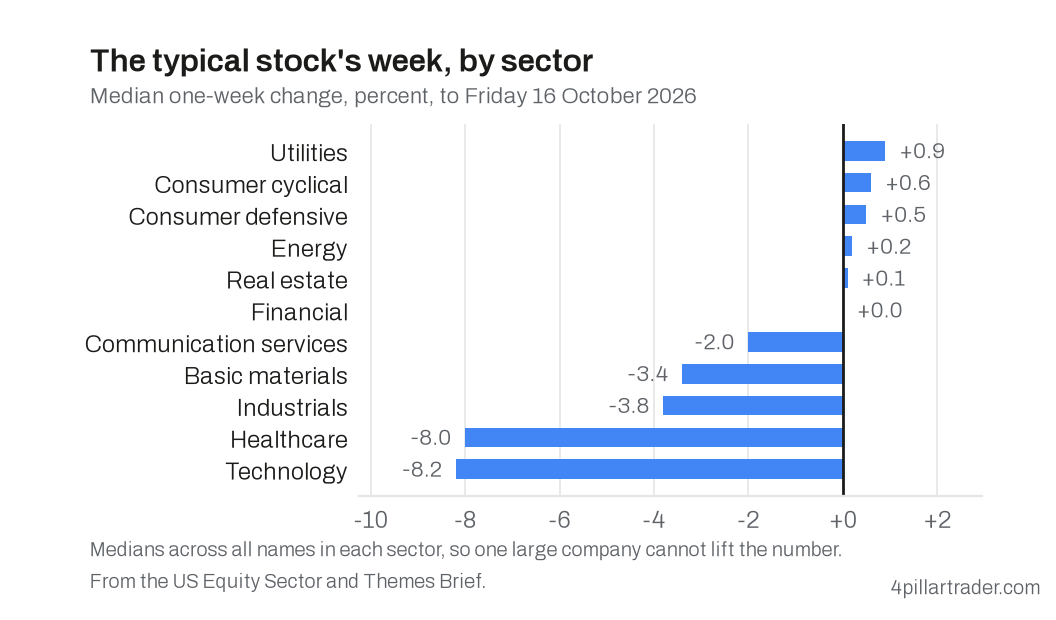
1. The Nasdaq fell 4.5 percent, its worst week since June, and chips did the damage. The Nasdaq closed the week at 26,140. Semiconductors and chip equipment had a median fall of 14.9 percent on the week, with only 4 percent of those names rising, and the main semiconductor index fell 11.4 percent. The S&P 500 fell 1.9 percent. The Dow, which holds fewer technology names, rose 0.7 percent.
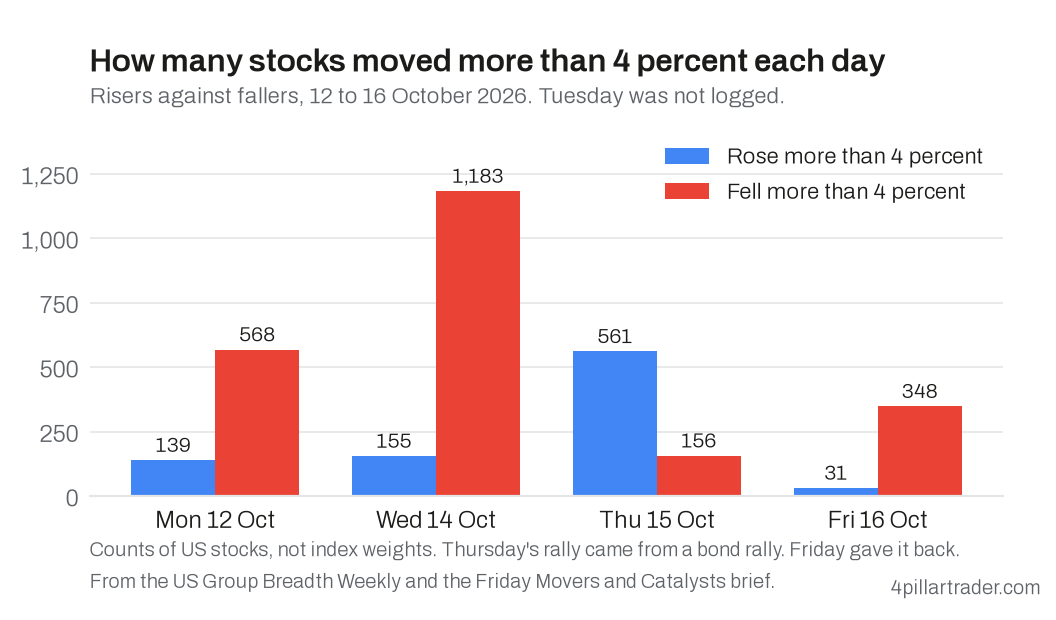
2. The selling was broad underneath, with one brief exception. Across the four sessions logged, 886 stocks rose more than 4 percent on a day and 2,255 fell more than 4 percent, a ratio of 0.39. Three of the four days were washouts. Thursday was a real thrust, with 3.6 risers for every faller, but it came from a bond rally rather than earnings, and Friday gave nearly all of it back with 31 risers against 348 fallers.
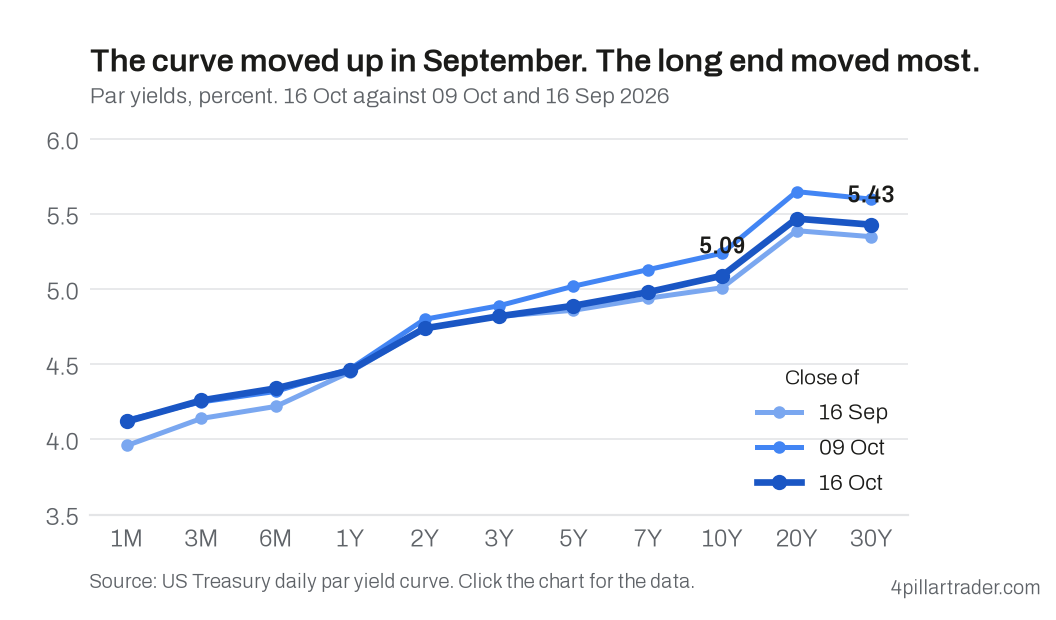
3. Bond yields fell into the selloff rather than rising on the inflation data. The 10-year yield, the rate almost everything else is priced off, ended the week at 5.09 percent, down from 5.24. Money leaving tech went into government bonds. Traders now put the next Fed rate rise in December rather than at the 28 October meeting.
4. Oil is the thread through everything. US crude settled at 101.41 dollars, up 10 percent on the week, and Brent touched 110. Oil pushed September's inflation up, it is what lifted energy stocks on Friday when nothing else rose, and it is the main reason the Fed cannot relax. Twenty of the twenty-eight operating companies that rose more than 4 percent on Friday were oil and gas producers, which you can see name by name in Friday's movers brief.
5. The weakness spread beyond the Nasdaq headline. Software, optics, storage, AI hosting and the power and nuclear names behind them all sold together. So did aerospace and defence, capital markets, electrical equipment, and engineering and construction, which are all adjacent to the AI build-out. This is not one sector having a bad week. It is one theme being repriced across several. The industry-by-industry counts are in the group breadth weekly.
What to pay attention to next
Each of these is a question with a clear answer coming.
- CoreWeave's credit. It is the stress gauge for the whole AI financing story. Its credit default swaps, the cost of insuring its debt, ended the week at distressed levels. If they narrow and chip stocks get back above their 50-day averages, the scare fades. If they widen further, expect the selling to keep spreading.
- Nvidia against the chip equipment makers. If the leader holds while equipment falls, the weakness is concentrated. If Nvidia breaks, it is spreading.
- Hyperscaler spending plans on Wednesday 21 October. Meta and Tesla report after the close. What they say about capital spending and how they fund it is the first direct test of the financing story.
- Oil above 100 dollars. The defensive rotation holds together while US crude stays above 100 with no easing in the Gulf. A sharp pullback in Brent would make Friday's energy bid look like a one-day move.
- A second thrust day. Thursday showed the market can rally hard. The first sign of real broadening would be a day like that holding into the next session without a bond rally behind it.
- The defensives' own earnings. Chubb reports this week and Procter and Gamble on Thursday 22 October, with Coca-Cola and Hilton the week after. Staples and insurers have led. Their results decide whether the rotation into them continues.
- The Fed on 28 October and the 10-year below 5 percent. The meeting is on 27 and 28 October and the market expects no move. A cooler run of inflation data or a 10-year yield settling below 5 percent would undercut the whole rates-and-financing read on tech.
This week's reports
Three PDFs, free, observation rather than advice. Email services do not carry attachments, so each one downloads from the site.

[[FILE: US Equity Sector and Themes Brief | /pdf/us-equity-sector-themes-brief-2026-10-16.pdf | Which sectors, industries and themes gained or lost ground, with the catalyst behind each move labelled confirmed or narrative.]]
[[FILE: US Movers and Catalysts, Friday 16 October | /pdf/us-movers-catalysts-2026-10-16.pdf | Every stock that moved more than 4 percent on Friday, grouped by industry, with the reason where there was one.]]
[[FILE: US Group Breadth Weekly | /pdf/us-group-breadth-weekly-2026-10-12.pdf | How many stocks rose or fell more than 4 percent each day, by industry group. The clearest picture of how broad the selling was.]]
That is the week. If one of these needs more explaining, hit reply and tell me which.
Speak soon,
The 4 Pillar Trader
4pillartrader.com
P.S. I'm a 4 Pillar Trading affiliate. If you join through my link I earn a commission.
Data as of: Prices to Friday 16 October 2026, US close. Group breadth covers four of the five sessions.

Weekly newsletter
Get the next issue in your inbox
That was one week's issue, exactly as it went out. Subscribe and the next one comes to you, with subscriber-only offers as they come. Unsubscribe in one click.
About the newsletter and every past issue →
The newsletter is educational and general in nature. It is not personal financial advice. See the financial disclaimer.