
Newsletter issue
The regime, the five findings, and what to watch this week: 2 November 2026
Three good days, then Friday. Intel broke the chips, the AI giants were sold on cash, and the money went to industrials, pharma and energy. Midterms Tuesday, jobs Friday.
Last updated
Hi,
Here is the week in three parts. The kind of market we are in, the findings that mattered most, and what to pay attention to next. The three reports behind it are at the bottom.
The regime
Three good days and one bad one, and the bad one was Friday.
Monday to Thursday the market was doing what it did the week before, only more so. Chips bounced for three sessions on a run of AI supply deals. Small companies and cyclicals led, with Tuesday the broadest day of the month. The Fed held on Wednesday. Growth came in strong on Thursday. Then on Friday Intel fell almost 29 percent, its worst day since 1974, after warning on profit, cash and PC demand, and the whole chip complex went with it. The semiconductor index fell 7.2 percent on the day and finished October down 15 percent.
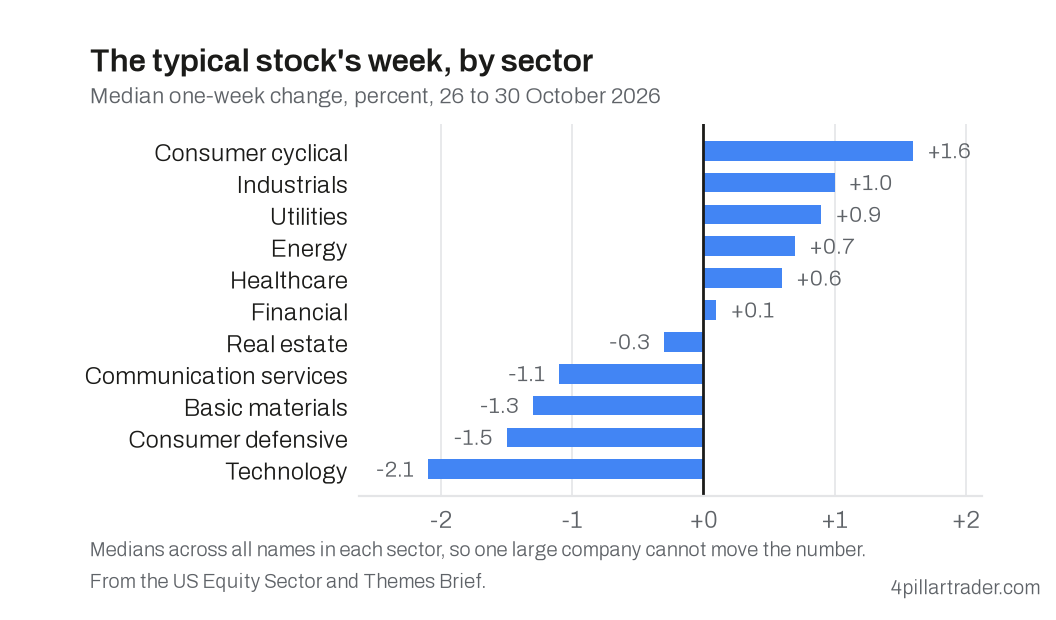
For the week, the S&P 500 fell 0.6 percent to 7,580 and the Nasdaq 2.0 percent, while the Russell 2000, the small company index, rose 1.3 percent. The typical stock in my core universe still rose 0.8 percent and 57 percent finished higher. Friday did not erase the week for most companies. It erased it for technology.
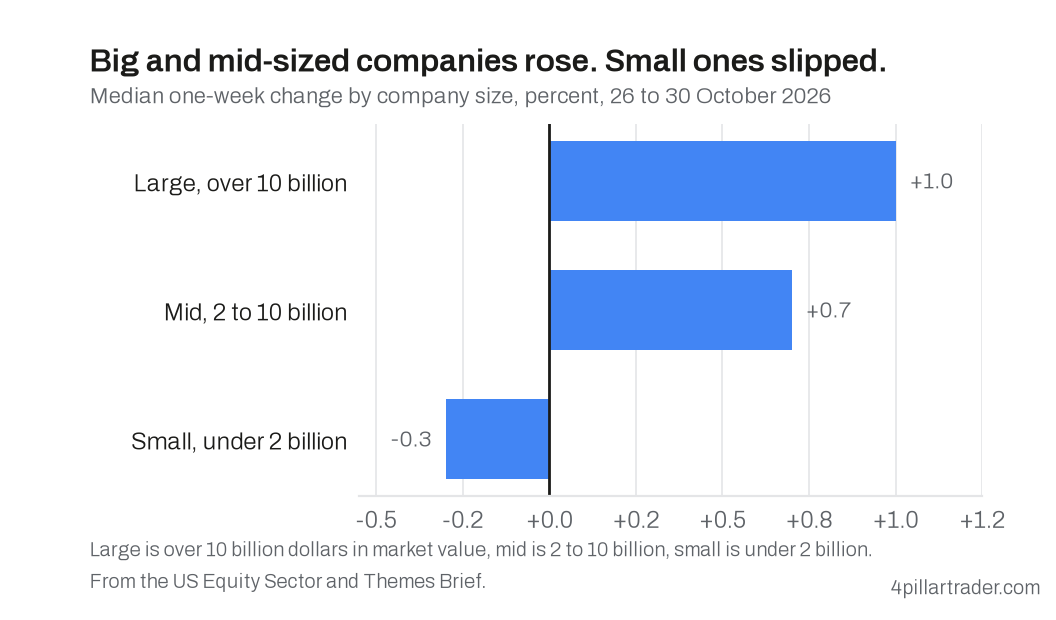
In plain terms. This is still a precautionary market. Money keeps moving out of the companies that spend the most on AI and into the ones that build the plant, pump the oil, or sell the medicine. What changed on Friday is that the chips, which had been the one part of the AI trade still working, stopped working too.
The five findings that mattered
1. The chips broke, and it was a single company that broke them. Only 1 of the 73 semiconductor and chip equipment names in my universe rose on Friday. The median fell 7.5 percent. AMD lost 10.9 percent, Qualcomm 11.1 and Nvidia 4.2. The semiconductor index closed below its 200-day average, and only 11 percent of chip names are above their 50-day. One week ago semiconductors were the group everyone expected to lead a recovery. The detail is in the sector and themes brief.
2. The AI giants kept beating on sales and kept getting sold on cash. Alphabet fell 12.6 percent on Thursday, its worst day since it listed, after a results miss and negative free cash flow, the cash left after spending. Amazon's free cash flow over twelve months came in at minus 42.4 billion dollars with its 220 billion spending plan unchanged. ServiceNow fell 34 percent on the week and Reddit 36 percent on guidance. Core software fell 3.1 percent with only a quarter of names rising. The test for this group has moved from whether demand is real to what the spending earns.
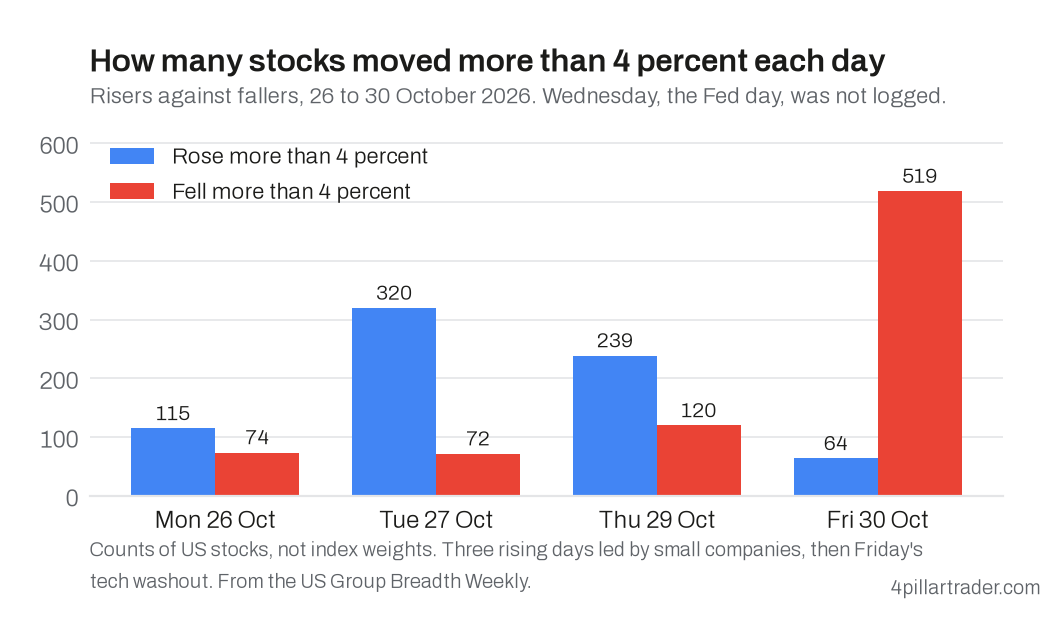
3. Breadth was fine until it was not. Across the four sessions logged, 738 stocks rose more than 4 percent on a day and 785 fell that much, a ratio of 0.94. Tuesday was a genuine thrust, 320 risers against 72 fallers, the broadest day of the month. Friday was a washout, 64 against 519, the second worst reading in my log. The selling hit the weak groups hardest, but 49 of Friday's fallers were among the strongest stocks in the market, so leaders were not spared. The day-by-day counts are in the group breadth weekly.
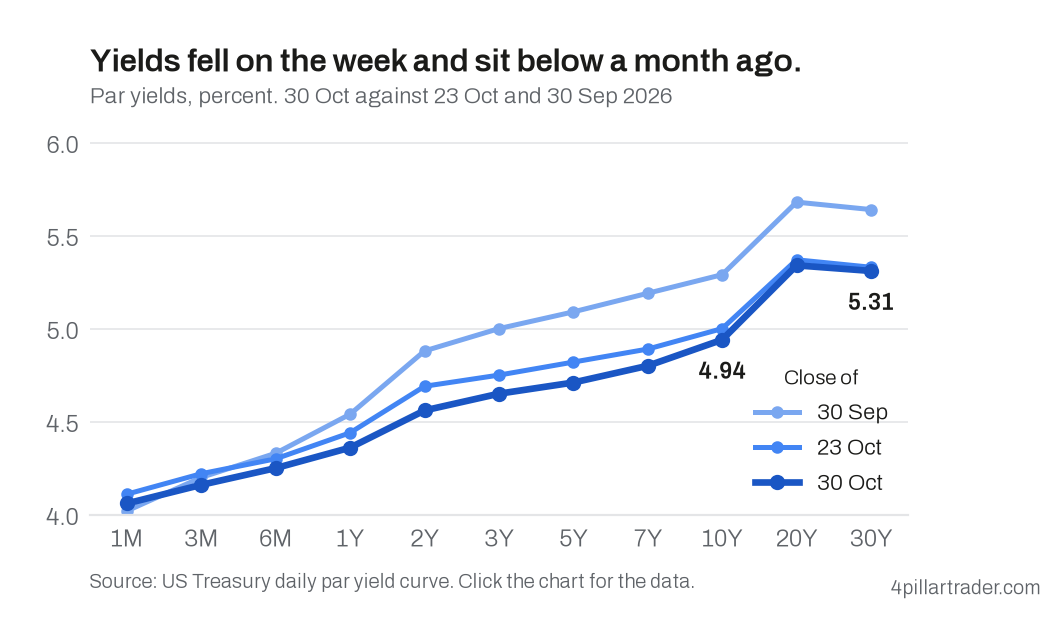
4. The Fed held with two dissents, growth beat, and yields fell anyway. The Fed kept rates at 3.75 to 4 percent in a 10 to 2 vote, with two members wanting a rise, and upgraded its view of growth to strong. The next morning the economy was shown growing at a 3.4 percent annual pace in the third quarter and September inflation on the Fed's preferred gauge was 3.6 percent. Traders put the odds of a December rise near 76 percent. Yet the 10-year yield, the rate almost everything else is priced off, ended the week at 4.94 percent, down 36 basis points over October. Friday's selling pushed money into government bonds.
5. Oil, pharma and the defensives took the money. US crude settled at 104.12 dollars on Friday after another tanker was hit near the Strait of Hormuz, and ExxonMobil and Chevron both beat on refining profits. Energy was Friday's best sector with 78 percent of producers up. Large drug makers rose 3.6 percent on the week, led by Regeneron up 15 percent on results. Utilities were the steadiest group, up 1.9 percent with 91 percent of names rising. Gold went the other way, falling 3.3 percent to a one-year low, and no precious-metal miner was spared. Friday's movers brief has every name.
What to pay attention to next
Each of these is a question with a clear answer coming.
- The midterms on Tuesday 3 November. Oil traders are bracing for a possible escalation with Iran after the vote. Does crude hold above 100 dollars once the result is known? A de-escalation that pulls Brent sharply lower removes energy's lead.
- Semiconductors after Intel. The test is simple. A quick recovery back above Thursday's levels makes Friday a one-stock flush. A second day with 50 or more chip names falling more than 4 percent confirms the break. Watch Nvidia, Broadcom and TSMC against their October lows.
- Apple, Palantir, AMD and Qualcomm. Apple and Palantir report Monday, AMD Tuesday and Qualcomm Wednesday. AMD and Qualcomm are the first chip guides since Intel's.
- Software selling in the strong names. If the high-strength software names keep falling, the AI disruption and cash-burn worry has moved from the laggards to the leaders.
- The jobs report on Friday 6 November. October payrolls land at 8.30 in the morning. Strong hiring with 3.6 percent inflation pushes December rate rise odds back above 85 percent and lifts short-term yields, which hurts the rate-sensitive groups that led this week.
- The 10-year near 5 percent. Rate-sensitive stocks led on falling yields. A move back above 5 percent, with housing, dealers and restaurants giving back Thursday's gains, would weaken the rotation.
- Inflation on 10 November and the Fed on 8 and 9 December. The October consumer price report is the last big print before the December meeting.
Want the process behind this?
Everything above comes from one way of working: read the macro backdrop, find what the money is doing underneath the index, pick the groups and companies worth researching, and size any position so a week like this one cannot hurt you. That is the four-pillar process, and it is what 4 Pillar Trading teaches live, with mentors who have institutional experience, in a community where ideas get pulled apart in the open.
The trial is 19 dollars for 30 days through my link. Cancel before day 31 and that is all you pay. Pricing and inclusions are set by 4 Pillar Trading and can change, so confirm the current terms on their page before you commit.
Affiliate link. I earn a commission if you join through it, at no extra cost to you. My full review sets out the limitations alongside the strengths.
This week's reports
Three PDFs, free, observation rather than advice. Email services do not carry attachments, so each one downloads from the site.

[[FILE: US Equity Sector and Themes Brief | /pdf/us-equity-sector-themes-brief-2026-10-30.pdf | Which sectors, industries and themes gained or lost ground over the week, with the catalyst behind each move labelled confirmed or narrative.]]
[[FILE: US Movers and Catalysts, Friday 30 October | /pdf/us-movers-catalysts-2026-10-30.pdf | Every stock that moved more than 4 percent on Friday, grouped by industry, with the reason where there was one.]]
[[FILE: US Group Breadth Weekly | /pdf/us-group-breadth-weekly-2026-10-26.pdf | How many stocks rose or fell more than 4 percent each day, by industry group, and which themes switched sides during the week.]]
That is the week. If one of these needs more explaining, hit reply and tell me which.
Speak soon,
The 4 Pillar Trader
4pillartrader.com
P.S. I'm a 4 Pillar Trading affiliate. If you join through my link I earn a commission.
Data as of: Prices to Friday 30 October 2026, US close. Daily breadth covers four of the five sessions.

Weekly newsletter
Get the next issue in your inbox
That was one week's issue, exactly as it went out. Subscribe and the next one comes to you, with subscriber-only offers as they come. Unsubscribe in one click.
About the newsletter and every past issue →
The newsletter is educational and general in nature. It is not personal financial advice. See the financial disclaimer.